From the department of “just in case you were wondering”…

We know that the Romans used the word Lambrusco.

In ancient Latin, it appears as lambruscum or labrusca. It denoted “wild grape varieties” and can be found in the works of writers like Pliny and Columella.

But the earliest known mention in the Italian language dates back to the early 14th century when Bolognese jurist and agriculturalist writer Pietro de’ Crescenzi used it to refer to the specific grape variety. At least so it is believed (according to top Italian lexicographers).

Images via the Wikipedia entry for Pietro de’ Crescenzi.

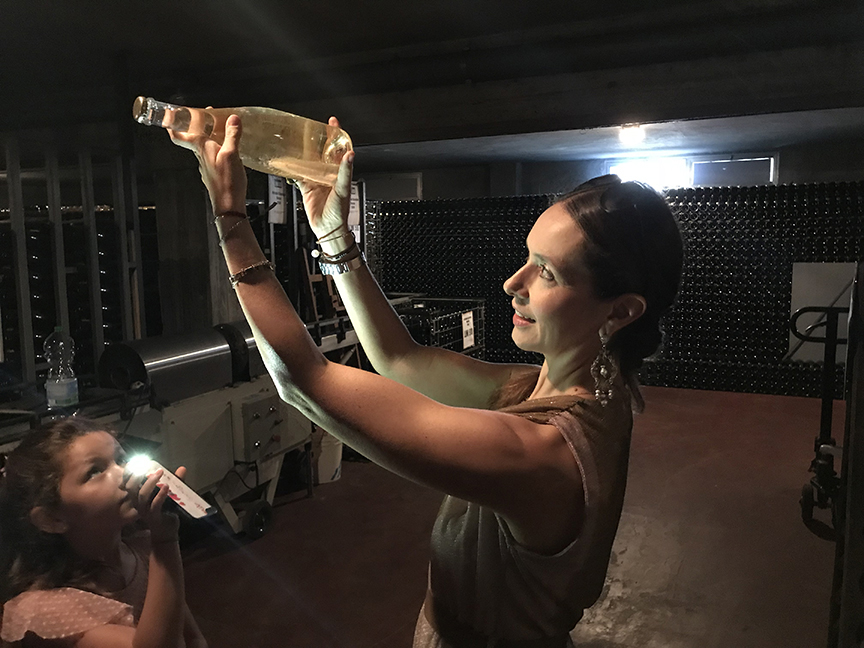
Above: Alicia examines a bottle of Lini classic method wine “aging on its lees.” As she holds it up to the light, you can see the “lees,” the sediment, in the bottom of the bottle.

What is “lees aging”? And why is it important in the production of sparkling wine?

You often hear wine trade professionals talk about this phase, a very particular one, in the sparkling winemaking process but few can really tell you what it means and why it’s a fundamental element in sparkling wine production.

Sparkling wine is always produced by fermenting the wine twice, the second time in a pressurized environment (either a tank or in the case of classic method wines, in bottles).

After the second fermentation of the wine, the wine is aged “on its lees.” Lees are the sediment (the solids) produced as a byproduct of fermentation. They are made up mostly of dead yeast cells (fermentation is the process of yeast converting sugar into alcohol) and cells from the grape must.

It’s during the period of lees aging that the wine develops a lot of its flavors and texture. In general, the longer the wine is aged on its lees, the better.

Lini 910 Lambrusco Metodo Classico
94 points

Wine Enthusiast
September 2023

The Lini family has been at the forefront of producing Lambrusco via the Champagne method since the 1970s, and this wine shows their expertise. Aged for 14 to 15 years on the lees, this 100% Lambrusco di Salamino is radiant with ripe cherries mixed with savory herbs, sweet spices and blueberry tart aromas. The palate is rich yet light with an acidity that keeps the palate fresh. The wine finishes with complex notes of plums, dried herbs and violets. Drink now–2035. — Jeff Porter

Jeff is one of the most renowned Italian-focused sommeliers and wine writers working in the U.S. today. We couldn’t be more thrilled by his review.

He also scored and reviewed all the current releases:

Lambrusco Labrusca Bianco
93 points

“Best Buy”

Lambrusco Labrusca Rosé
90 points

“Best Buy”

Lambrusco Labrusca Rosso
92 points

“Best Buy”

Lambrusco Labrusca Riserva
90 points

Click here for all of Jeff’s recent reviews of Lini 910.

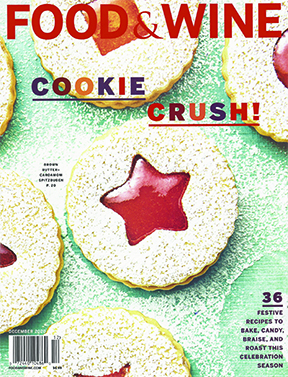
Above: The Lini family was featured in the 2020 holiday issue of Food & Wine magazine.

Since 1910, four generations of the Lini family have produced traditional-style Lambrusco at their winery in the province of Reggio Emilia (northern Italy). Even as other Lambrusco growers and winemaker followed market trends in places like the U.S. where sweet-style Lambrusco became wildly popular in the 1970s, the Lini have never strayed from their passion for dry Lambrusco, the kind that the Emilians drink themselves. One of the keys to Lini 910’s success is their steadfast belief that great Lambrusco takes time: The winery patiently ages all of its wines until they are ready to be released. As a result, the wines have brilliant aromas and flavors that set them apart from the crowd. As the interest in traditional-style Lambrusco grew in the 2000s, Lini 910’s wines once again became a favorite of consumers and critics alike. Their Classic Method Lambrusco, made like a Champagne, has been called “the best Lambrusco of all time” by one of Italy’s leading wine writers. And the wines regularly receive 90+ scores from American critics at magazines like Wine Spectator and Wine Enthusiast.

That’s the tasting laboratory at the offices of Wine Spectator magazine in midtown Manhattan.

And here are the magazine’s most recent scores for our wines.

Lambrusco In Correggio Scuro 89 (2020)
Lambrusco In Correggio Rosé 89 (2020)
Lambrusco Labrusca Rosso 88 (2020)
Lambrusco Labrusca Rosé 88 (2020)

You may remember that the editors named the Lini Lambrusco Labrusca Rosé their number-one “Best Sparkling Value” back in 2019.

And in 2020 they named the Lini Lambrusco Labrusca Rosso one of their overall “Best Values.”

Those are just a few highlights from our recent mentions and accolades in the U.S. media.

See all of our mentions in the press here.

We couldn’t be more thrilled to share the news that the Lini family and its wines are featured in the December issue of Food & Wine magazine.

“To some people,” writes Food & Wine executive wine editor Ray Isle, “it might come as a surprise that there is good Lambrusco. The wine’s image has long battled against the impression that it’s a slightly sweet, innocuous, fizzy pink drink… But traditional Lambrusco is dry and crisp, an excellent foil for the rich food of Emilia-Romagna. Alicia’s father, Fabio, who makes the Lini wine, says, ‘If you drink a glass of 15% alcohol wine, you get drunk on one glass. With Lambrusco, you can drink more glasses — quality with quantity ! — and not feel bad. Balance and drinkability is our goal. And that the day after, you feel good.”

The magazine should be hitting newsstands and bookstores early next week.

Check out “Pop Fizz Feast: In the hills of Emilia-Romagna, a Lambrusco-making family uncorks the holiday season with a joyful meal — and plenty of great sparkling wine,” including Alicia’s family recipes for their holiday celebration.

There’s a saying often repeated among American food and wine professionals (the first time our American blogger heard it, it was uttered by legendary restaurateur Danny Meyer): If it grows with it, it goes with it.

We just loved this post by veteran wine blogger and writer Vicki Denig on “The wines to drink with 7 iconic Italian dishes.”

White truffles from Piedmont? Nebbiolo (check!)

Bistecca fiorentina? Chianti (is there any other?)

Trenette with Pesto? Vermentino (so good)

And, of course, ragù alla bolognese? None other than Lambrusco!

When you travel to Emilia, you’ll find that the Emilians drink nothing but Lambrusco. It’s the canonical pairing for their style of cooking and their famous food products (Prosciutto di Parma, Culatello, salumi, Parmigiano Reggiano, etc.).

Italy’s intrinsic regionalism is part of what makes the mosaic of its gastronomy so fascinating and compelling.

We couldn’t have been more thrilled that Vicki recommended our wines in her post.

Thank you, Vicki!

Click here for the post.

“It is not easy,” writes longtime Italian wine critic and expert Daniele Cernilli and one of the founders of Gambero Rosso, “even for a Lambrusco aficionado, to imagine what a Lambrusco made with the classic method and disgorged 19 years after the harvest might be. The only way to know is to taste Lini 910’s In Correggio Rosso Millesimato DT 2004.”

“Those crazy people at Lini 910 bring out a few thousand bottles of something incredible. The 2004 In Correggio, a classic method with 18 years on the lees. What are we to say?”

Lini 910’s Lambrusco Metodo Classico is “the finest ever tasted. The best Lambrusco of our lifetime,” he writes toward the end of his review.

Click here for the complete article (in English).

Above: Lini 910 has been certified sustainable since 2021. “We’ve always been a sustainable winery,” reads the caption below, “but we have been Equalitas certified since July 2021.”

The historic Lini 910 winery in Correggio (Reggio Emilia province, Emilia-Romagna) is the first winery in Emilia to have obtained “Sustainability Certification” according to the strict standards established by the Italian certification organization Equalitas.

Equalitas is a project launched by Federdoc and the Unione Italiana Vini, the two leading winery associations in Italy. Its goal is to promote a unique approach to sustainability in the Italian wine industry. It’s based on three “pillars”: social, environmental, and economic.

“With this important certification,” says the Lini family, “we have achieved a long-time goal of ours: Sharing our care for the environment and natural resources with our clients and with lovers of Lambrusco and Classic Method sparkling wines throughout the world. It’s a reflection of our winemaking philosophy and our respect for the earth and our land.”