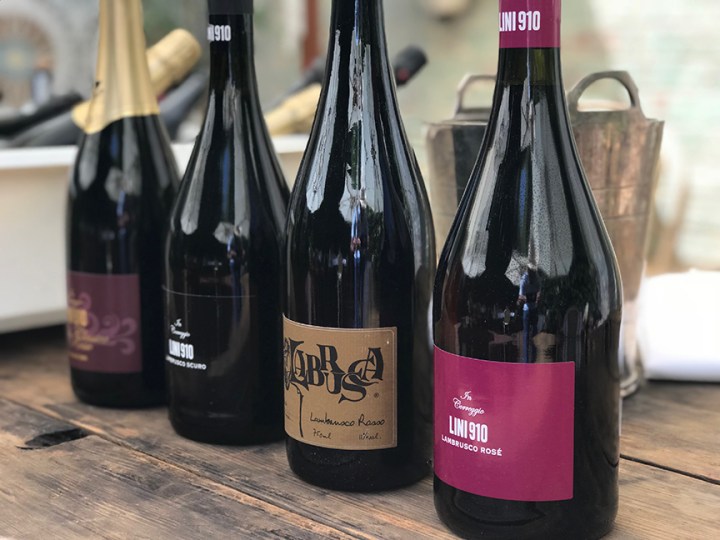
For those of you attending Vinitaly this year, we hope to see you at the Lini stand: Hall 3, Stand C6.

The Lini family couldn’t be more thrilled to share the news that its wines are now imported to the U.S. by Winebow-Leonardo LoCascio Selections — the leading importer of Italian wines in America.

Founded in 1980, Winebow has reshaped the Italian wine market in the U.S. by introducing some of Italy’s most iconic wineries to American restaurateurs, retailers, and consumers. Today, its distribution network is considered the gold standard among Italian wine trade members and observers.

“Each wine in the collection tells a unique story about the family and region that produced it. A taste through the portfolio is a journey across Italy’s rich spectrum of geography, history, and culture” (from the Winebow-Leonardo LoCascio Selections website).

Lini will take part this year in the Winebow-Leonardo LoCascio Selections Vini d’Italia tour in May and the wines, which have already landed in the U.S., will be available shortly.

For those of you attending Vinitaly this year, we hope to see you at the Lini stand: Hall 3, Stand C6.

Few English-speaking readers beyond southeast Texas and Louisiana will know what boudin is.

Well, they might know European boudin noir, the classic blood sausage found in many countries across the continent and even in Italy.

But unless you’ve spent some time along the Gulf Coast of the southeastern U.S., otherwise known as lagniappe country, you’ve probably never experienced Cajun boudin.

Also known as boudin blanc, it’s a type of sausage made with pork, rice, and spices (here’s a cool video on how boudin is made).

One of the ways that boudin is typically served is as “boudin balls”: The sausage is de-cased, crumbled, formed into balls, and then battered and fried.

It’s a classic dish along the Gulf Coast where our English-language blogger Jeremy lives.

He and his family recently paired homemade boudin balls with Lini Lambrusco Labrusca Rosato.

“It’s a spicy dish,” said Jeremy, “and needs a really fresh wine. It’s also a really fat-laden dish that in many ways mirrors the pork-heavy diet of the Emilians. The acidity and the bright fruit flavors worked great with the heat and the fat. And the wine’s lithe character was a counterpoint to the ‘stick-to-your-ribs’ earthy character of the sausage.”

Could Lambrusco be the ultimate pairing for Cajun cuisine?

Based on this initial experience (the first in our ongoing research), it might just be!

For those of you attending Vinitaly this year, we hope to see you at the Lini stand: Hall 3, Stand C6.

Lini will also be poured in a fantastic flight of wines to be presented by Daniele Cernilli (above), one of Italy’s leading wine writers and wine critics.

On Sunday, April 7 (the first day of the fair), he’s leading a 2 p.m. seminar on sparkling wine that will include the Lini 2006 Lambrusco Metodo Classico.

It’s one not to miss!

Click here for info and registration details.

According to a feature story published in the finance section of the Italian national daily La Stampa last week, “Americans are going crazy for Italian sparkling wines.”

“Sparkling wine is leading ‘made in Italy’ wines in the U.S.,” writes the author of the piece.

“The most recent data shared by the [Italian] Trade Commission in America taste like an important milestone for Italy. In 2018, [Italian] wine exports grew by 6.8 percent in terms of value… the highest increase over the last 5 years and 1.2 percent higher than the previous year… the United States has established itself as the top market for Italian wine exports. It takes in roughly a quarter of the total number of bottles sold abroad.”

But the best news for sparkling wine producers is that Americans have become the leading consumers of Italian bubbles as well.

“Italy is the top supplier of white wines in the U.S., accounting for 40 percent of the market. It’s also the top supplier of red wines, accounting for 32.5 percent. And in the sparkling wine category, [Italy] dominates the market in terms of quantities with 57 percent of imports.”

At Vinitaly this year, Lini 910 will be sharing some big news as it begins a new chapter in its market presence in America. Stay tuned!

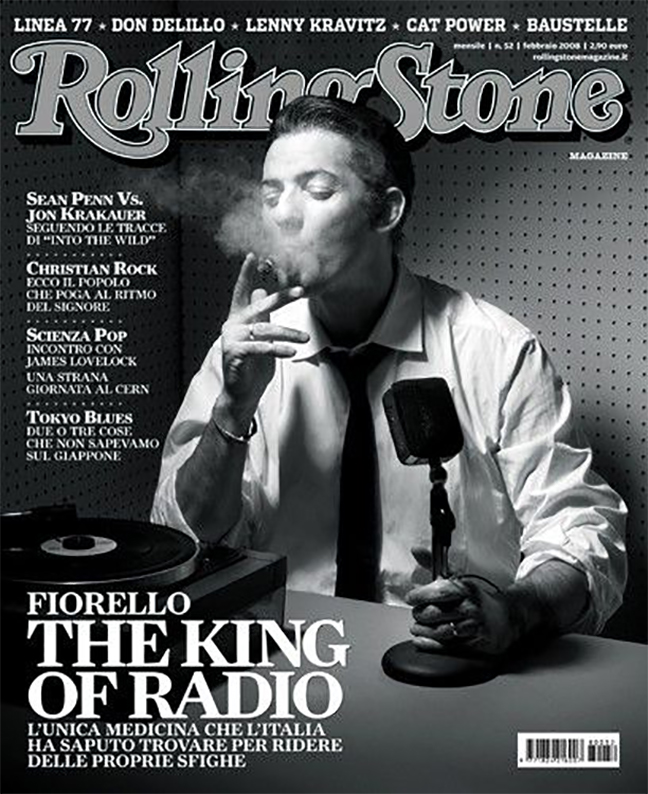
Alicia Lini recently came across this 20018 Rolling Stone review by Filippo Polidori, one of Italy’s leading influencers. In his article, he pairs Lini Lambrusco Scuro with Bruce Springsteen’s “Born to Run” and he quotes “his friend” Oliviero Toscani, the celebrated Italian photographer.

Their conclusion? There is no wine hipper than Lambrusco.

We’ve translated the piece in its entirety here. Enjoy!
Did you know that Lambrusco used to be as popular in the U.S. as it was in Italy?

By the end of the 1970s, 50 percent of the Italian wine exported to the U.S. was Lambrusco, although that trend changed.

But as often happens, neither man nor the market are always grateful.

Despite the hard work of Lambrusco producers, for years their wines were consumed almost exclusively in the region where they were produced.

25 years later Lambrusco has returned and people are talking about it.

Today [2008], Lambrusco is the biggest selling wine in Brazil.

Its popularity is owed to its simplicity, to its directness.

Once, when I happened to be talking with my friend, the often genius Oliverio Toscani [the famous Italian photographer], he offered this definition:

“A wine that got around because it was an easy hook-up.”

Lambrusco’s strength comes from its easygoing nature. But it’s also what holds it back.

In recent years, concentrated, muscular, steroid-driven wines have been the trend. And simplicity is seen as banality.

But despite these challenges, Lambrusco has returned to the top and people love it again. It’s “vintage” and young people like that.

Oliveri Toscani had this to say: “Lambrusco is the true wine of Italy. It’s like Marcello Mastroianni. Who could be better than him to represent Italy? Lambrusco has an Italian face. But we Italians are embarrassed by it because it’s not trendy. It’s ridiculous. Actually, Lambrusco is trendy, more so than other wines! If Italians were truly chic, they would get it.”

This is Lambrusco! A human wine that allows you to drink well without expecting payback.

When I sat down to write this article, I picked a CD that represented two different musical souls: Rock and folk.

Bruce Springsteen is just the right artist and “Born to Run” is the perfect sound track.

The wine I chose is Lini 910 Lambrusco Scuro.

From the moment you pour it into the glass, the brilliant ruby red color and the aromas of cherry and strawberry let you know you are with someone “simpatico.” This Lambrusco needs no introduction to be appreciated. It’s testament to simplicity’s greatness.

Filippo Polidori
Rolling Stone (Italia)
February 2008

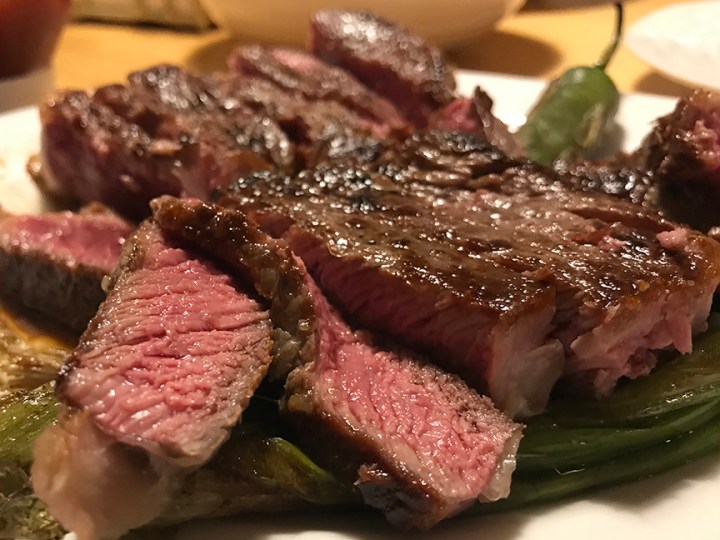
Here at our house, one of our favorite Sunday night traditions is steak and French fries dinner. We pan-fire prime New York strip steaks from our favorite local butcher and we roast hand-cut French fries.

Just to give the steak some added flavor, I’ll also sauté a large jalapeño pepper and some scallions in the same pan (I generally start cook the pepper and scallions before I add the steak, which I rub generously with kosher salt and freshly cracked pepper).

It’s all-American evening in Houston, Texas, where we also usually watch a movie together for the occasion.

Americans are so hung up on drinking “big” tannic wine with steak. They often think that Cabernet Sauvignon — and in particular, Napa Valley Cabernet Sauvignon, with its signature “big” style — is the only wine category worth of a great piece of beef.

It doesn’t occur to most that Lambrusco is actually a very tannic grape. And few know that it makes for a sublime pairing with charred steak like the ones we like to make a couple of times of month (after all, we have two little kids at home and steak is a great excuse to get them to enjoy protein).

Of course, like any good Texan, I like my steak served with a little bit of heat, hence the jalapeño and the habanero-based sauce I like to use with my beef.

That’s another reason why I like serving Lambrusco with steak: Because it’s served chilled and because it sparkles with freshness, the heat doesn’t overwhelm it the way it would a Nebbiolo or a tannic Pinot Noir, for example.

The next time you sit down to a great hunk of beef, pop open a bottle of Lambrusco. Trust me: you’ll thank us.

Jeremy Parzen
blog master

It’s not every week that you discover that your wine is being poured in the legendary Harvard Square in Cambridge, Massachusetts, the “historic heart” of Harvard University!

This week and next, Grafton Street Pub — a favorite destination for students and professors — is serving Lini Lambrusco as part of their Winter Dine Out menu (check it out on the Harvard Square website!).

The pairing? Tuna tartare with avocado yogurt, black radish, sesame, togarashi wonton chips.

Sound delicious!

The menu, with wine pairings, is available through March 15.

Go Crimson!

Grafton Street Pub & Grill
1230 Massachusetts Ave.
Cambridge MA 02138
(617) 497-0400
Google map

Image via the Grafton Street Facebook.

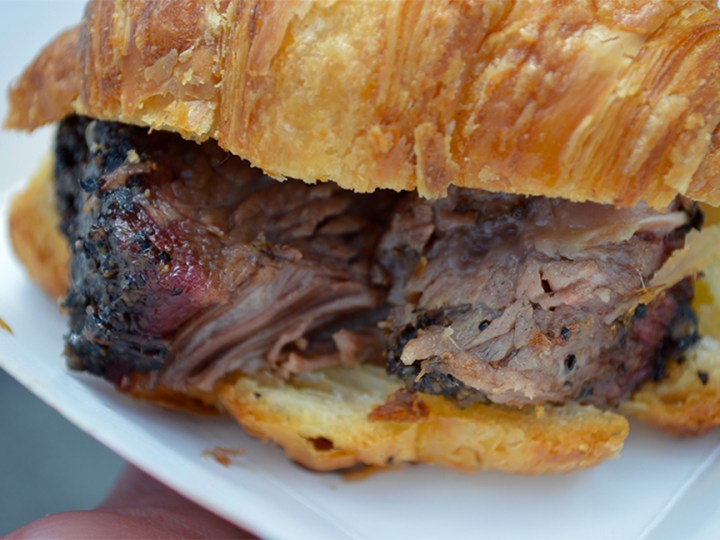
Above: Classic smoked beef rib, a staple of Texas BBQ, served on a croissant in Houston, Texas.

Earlier this week, I was invited to speak at a private gathering with three of Houston’s leading “pit masters” (otherwise known as “smokers,” pit masters smoke meat; the name comes from the fact that in another era, the meat was smoked over a pit of smoking embers).

Our task was to determine what Italian wines go best with Texas BBQ (please keep in mind that the term barbecue has a particular meaning in Texas: it denotes “dry-rub” smoked meats, mostly beef, that have been seasoned solely with dry spices, mostly salt and pepper).

As someone who has been working in Italian wine for more than 20 years, I have no doubt that Lambrusco is the ideal wine pairing for Texas BBQ, even better imho than beer.

When it was my turn to speak, here’s the analogy I drew.

One of the most iconic dishes in Emilian cuisine is boiled meats. A number of different cuts of meat, including beef round and tongue and chicken, are slow-cooked together in simmering water and then are sliced and served accompanied by mostarda, spicy pickled fruits.

It is served exclusively, solely, and canonically with Lambrusco.

You have all of the elements of Texas BBQ — minus the smoke.

Protein? Check.

Fat? Check.

Tender, melt-in-your-mouth texture? Check.

Heat (in the form of mostarda, akin to the spicy vinegar-based sauces served with Texas BBQ)? Check.

The parallels are all there (again, minus the smoke and smokiness).

And so I rest my case: Lambrusco is the ULTIMATE pairing for Texas BBQ!

Don’t believe me? Come visit me in Texas and the ‘cue and the Lambrusco is on me!

Jeremy Parzen
Lini blogmaster

Some people point to Shakespeare’s celebrated line from “Romeo and Juliet” as one of the most famous instances when a rose is invoked to express love and passion.

What’s in a name? That which we call a rose
By any other word would smell as sweet.

But the rose’s long association with romance goes back much further.

In fact, we have to reach back to the 13th-century French allegorical poem known as the Róman de la Rose or Romance of the Rose.

At the outset of this story of courtly love, the narrator tells us:

If anyone asks what I wish the romance to be called, which I begin here, it is the Romance of the Rose, in which the whole art of love is contained. Its matter is good and new; and God grant that she for whom I have undertaken it may receive it with grace. It is she who is so precious and so worthy to be loved that she should be called Rose.

Since the Middle Ages, the rose and the color of the rose have been associated with romance.

It’s no wonder that our Valentine’s Day celebrations are always rose-hued!

What will you be drinking on Valentine’s Day this year?

For your consideration: Wine Spectator’s “BEST VALUE SPARKLING” — Lini Lambrusco Rosé.

For your consideration…

Valentine’s Day is around the corner and we know that a lot of you are making plans to celebrate the holiday with that special someone. And we know that for many of you, picking the right wine is key to making the event memorable.

Here are some of the reasons we think that Lini Lambrusco Rosé is the ultimate Valentine’s Day wine.

1) It’s pink. The rose color is a perfect match for the holiday.

2) It sparkles. It’s a truly joyous wine and a great conversation starter.

3) It’s super food-friendly and can be paired with a wide variety of cuisines, perfect for date night when you night need pairing options.

4) Its alcohol is restrained. You definitely want a wine that you can enjoy liberally on Valentine’s Day.

5) It’s not cost-prohibitive. Opening a second bottle won’t break the bank.

Happy Valentine’s Day, everyone!